
How Bench Warrants Work in New Haven
Bench warrants in New Haven do not come from a county sheriff or a city municipal court. They come from the Connecticut Superior Court, and each one ties back to an open case. That case might be criminal, motor vehicle, probation, or something else the court is already handling. A missed court date is the most common trigger. Breaking a release term, ignoring a probation rule, or defying a direct court order can also produce a bench warrant, a violation-of-probation warrant, or an order to incarcerate, so the docket and its exact label matter when you plan a next step. The warrant itself authorizes custody so the case can come back before a judge. Serving it does not close the older matter. When you ask the clerk about status, the answer will be active, served, recalled, or quashed. Recalled means the issuing court withdrew the order. Quashed means a court order nullified it. A current docket beats an old search screen every time.
New Haven FTA Case Path
A New Haven failure-to-appear matter often follows this path: court date → missed appearance → judicial review → bench or FTA warrant → service, recall, or a new appearance. The Judicial Branch VOP/FTA search covers limited categories and warns that FTA warrants will not be displayed until further notice. That makes the related docket search vital.
The Connecticut release and bail statutes set the legal framework for presentation and release after a New Haven arrest on a court warrant.
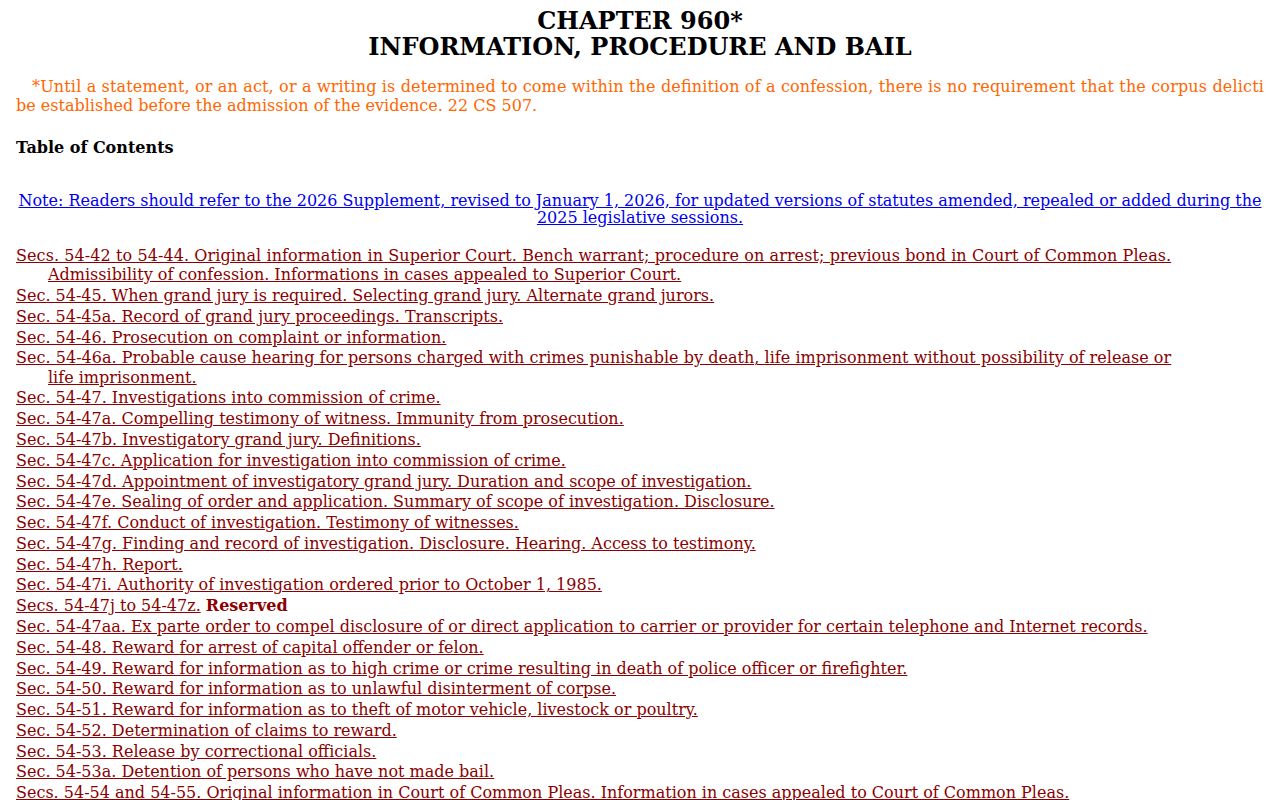
The statute view explains what follows service. It cannot tell you whether a specific New Haven warrant is active, and it sets no universal bond. The issuing clerk must confirm the current order and the case route. Note: A public display is only a lead; the issuing New Haven clerk must confirm the current bench-warrant status.
Bench Warrant Issuance in New Haven
A Connecticut Superior Court judicial authority issues the warrant after finding the required basis. In New Haven, the case may sit in the Judicial District for serious Part A work or in Geographical Area No. 23 for local Part B criminal and motor-vehicle matters. Once issued, warrant data can move from the Criminal Motor Vehicle System into PRAWN, the Paperless Arrest Warrant Network. PRAWN lets authorized justice agencies locate warrant details, find the responsible agency, and process service. It has no public registration or public search. Police may serve criminal warrants. Probation officers can act in suitable VOP cases, and judicial marshals handle courthouse custody functions. Connecticut abolished county sheriffs, so no New Haven County Sheriff's Warrant Division exists.
New Haven Clerk and Bail Route
GA 23 at 121 Elm Street handles listed criminal, motor-vehicle, traffic-ticket, and infraction work. Call the clerk/public information line at (203) 789-7461 during clerk hours, Monday through Friday, 9:00 a.m. to 5:00 p.m. Bail Services is (203) 789-7482. Serious Part A matters route to the New Haven Judicial District at 235 Church Street, where the Chief Clerk's Office is (203) 503-6800.
Superior Court GA 23
121 Elm Street, New Haven, CT 06510
(203) 789-7461
Local criminal, traffic, bench-warrant, and FTA case questions.
New Haven Judicial District
235 Church Street, New Haven, CT 06510
(203) 503-6800
Serious Part A cases and district-level warrant records.
Have the legal name, birth date, docket, approximate case date, and notice ready. Ask which court controls the matter, what action is required, and whether Bail Services is the next contact. Clerks give process information, not legal advice.
How Bench and Arrest Warrants Differ
Both orders authorize custody. Their starting points differ, though. A New Haven bench warrant usually grows out of a duty the court already imposed. An arrest warrant starts instead from probable cause that an offense occurred and that the named person took part in it. That difference shapes the record and the safest response.
| Feature | Bench warrant | Arrest warrant |
|---|---|---|
| Trigger | Missed date or noncompliance | Probable-cause application |
| Case | Usually an existing docket | May begin a new case |
| First contact | Issuing court clerk | Counsel and issuing court |
| Path | Recall, reset, appearance, or surrender | Surrender, booking, release, and court |
The New Haven arrest warrant lookup covers the probable-cause route. Handle either warrant through the court, not a public result alone.
New Haven Bench Arrest Rules
Connecticut General Statutes §54-64b makes the warrant's own terms control after arrest. If the judge denied bail or ordered presentation to the clerk, the officer brings the person without undue delay to the proper geographical-area clerk during clerk hours. When the clerk is closed, the law provides a correctional-center route. Other warrants follow the applicable pretrial-release process.
Caution: Never assume an old bond figure controls; the current judicial order and issuing New Haven clerk determine the release path.
The GA 23 guide identifies Bail Services, judicial marshals, and cell-block functions. It publishes no single bond schedule for all warrants. Cash, surety, a licensed bondsperson, real estate, personal recognizance, or a presentation order may apply only as the court directs. Posting bond secures appearance. It does not dispose of the case.
Clearing a Bench Warrant in New Haven
No official New Haven source promises a walk-in window, an amnesty event, or a fixed recall fee. The court may require a new date, a motion, a planned walk-through, a surrender, or bond. Counsel can help when arrest is possible or the reason for the missed date is disputed.
- Gather the notice, legal name, birth date, docket, and ticket or probation details.
- Check the VOP/FTA page and related criminal or motor-vehicle docket.
- Call GA 23 or the Judicial District clerk and ask if the warrant is active.
- Ask whether Bail Services, Adult Probation, or counsel is the next contact.
- Complete the court-directed motion, appearance, surrender, or release step.
- Keep written proof and confirm that the clerk recorded the action.
Adult Probation at 867 State Street, (203) 789-7876, can help identify a supervision contact for a VOP issue. Do not assume staff there can recall a judicial warrant. The New Haven guide also lists a public defender contact, though eligibility and representation depend on the case.
New Haven Civil Capias Distinction
A family-support capias is not a criminal bench warrant. The State Marshal Commission manual treats capias or capias mittimus as civil arrest process, triggered by failure to appear after service or by violating an order. In New Haven family-support cases, the missed appearance is what matters. Owing support alone is not the arrest basis.
- Bench warrant
- A criminal court order often based on a missed date.
- FTA
- Failure to appear at a required court event.
- VOP
- An alleged violation of probation.
- Capias mittimus
- A civil custody order that an authorized state marshal may serve.
Support Enforcement Services at 414 Chapel Street, (203) 789-7485, handles New Haven family-support matters. A state marshal serves the civil order. NHPD Records is not the issuing court, so it cannot clear the capias.
New Haven Courts That Issue Bench Warrants
Docket and location tell you where a New Haven case belongs. Connecticut dockets often carry a location prefix, case code, year, unique number, and suffix. Codes you may see include CR for criminal, MV for motor vehicle, CI for criminal infraction, and MI for motor-vehicle infraction. A neutral pattern like N23N-CR-26-0000000-S shows the format only. It is not a real case.
| Court | New Haven GA 23 or New Haven Judicial District |
|---|---|
| Matter | Criminal, motor vehicle, probation, traffic, or family support |
| Status | Active, served, recalled, quashed, or pending context |
| Release | May require direct clerk confirmation |
Juvenile Matters at 239 Whalley Avenue holds restricted juvenile cases. Family support keeps its own capias route in New Haven. The City Clerk and NHPD Records may hold city papers, but only the Superior Court clerk carries the live order.
Confirming New Haven Warrant Recall
Resolving a New Haven warrant has two parts. You address the warrant itself, then the case moves forward. Get something in writing: a receipt, an order, a new court date, release papers, or proof of recall. Ask the clerk when the online docket should update. Public pages lag, and they omit restricted facts, so a blank result later means less than the court's own record does. If a motor-vehicle matter also suspended your license, court clearance and DMV restoration stay separate in New Haven. Keep proof from both. NHPD Records at (203) 946-6312 can explain police-report requests, but a city request never reaches a Judicial Branch file or PRAWN. The Connecticut FOIA does not open sealed, juvenile, safety-sensitive, or exempt investigation material either. Note: Keep the court order and any DMV confirmation together, since each agency updates its own system on a separate schedule.